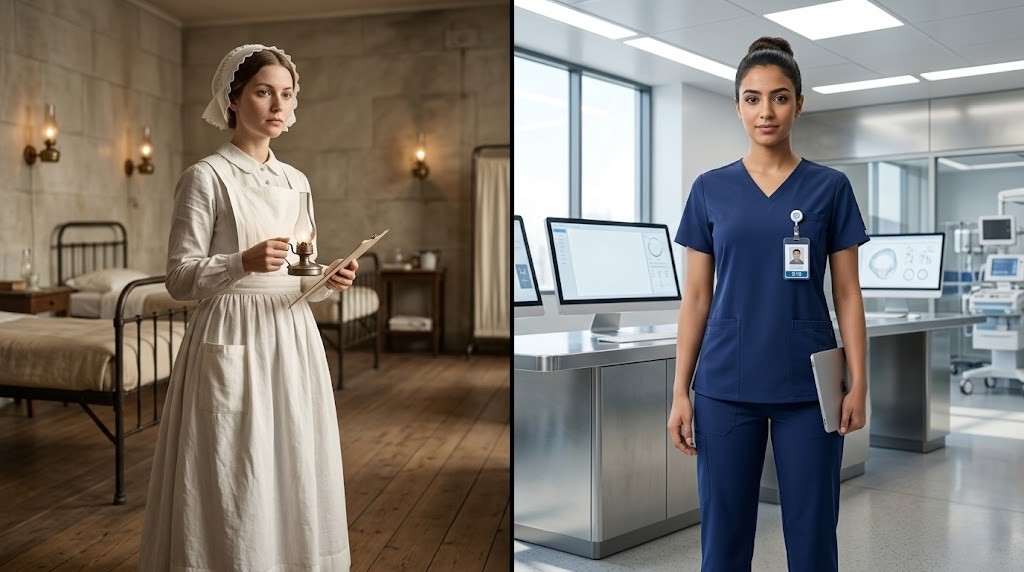
Nursing uniforms have moved from symbolic white dresses to highly functional scrubs—this overview traces key shifts driven by hygiene, professional identity, gender roles, and clinical needs from the 19th century to today.
Introduction: Why Nursing Uniforms Matter
The history of nursing uniforms is a mirror reflecting the evolution of healthcare science and the social status of the profession. For over 150 years, the garments worn by nurses have functioned as both essential tools for clinical labor and powerful symbols of authority, cleanliness, and care.
Uniforms as Tools and Symbols
A uniform serves as a functional asset, designed to withstand the physical rigors of a shift while protecting the wearer from contaminants. Simultaneously, it acts as a visual shorthand for professional identity, fostering immediate trust between a clinician and their patient. As the profession advanced from domestic service to a high-tech medical discipline, the requirements for these garments shifted from symbolic modesty to athletic performance.
Overview of Themes
The evolution of scrubs and earlier uniforms is defined by four consistent themes: the pursuit of better hygiene, the demand for increased physical mobility, the shifting landscape of gender roles, and the ongoing professionalization of nursing. From heavy Victorian pinafores to modern antimicrobial fabrics, every design change has been an answer to a specific clinical or social challenge.
19th Century Origins: Florence Nightingale and the White Dress
Before the mid-1800s, nursing was often seen as either domestic service or a charitable act performed by religious orders. It was during the Crimean War that the uniform began its journey toward standardization under the influence of Florence Nightingale.
Nightingale’s Influence: Modesty and Order
Nightingale understood that for nursing to be respected as a profession, nurses had to look the part. She introduced the concept of a standardized dress that signaled order, discipline, and moral duty. The symbolic white dress emerged as a powerful icon of cleanliness; in an era before the full understanding of germ theory, the ability to maintain a pristine white garment suggested a high level of sanitary care and dedication.
Practical Limits of the Era
Despite their symbolic power, these vintage nurse uniforms were remarkably impractical by modern standards. They consisted of heavy, floor-length fabrics, stiffened collars, and large aprons. While the aprons were intended to protect the dress, the overall ensemble was restrictive and difficult to launder. These early uniforms still reflected the domestic associations of the time, emphasizing the nurse’s role as a “lady of the lamp” rather than a clinical technician.
Early 20th Century: Professionalization and Tailored Uniforms
By the turn of the 20th century, nursing schools were flourishing, and the uniform became a marker of education and rank.
Nursing Schools and Hierarchy
Standardization became the norm as nursing schools developed their own unique uniform styles. The introduction of starched pinafores and tailored dresses helped distinguish students from graduates. Perhaps the most significant accessory was the nursing cap. Initially designed to keep hair neatly tucked away for hygiene, cap styles eventually became complex badges of hierarchy, with specific pleats or stripes denoting a nurse’s school and level of seniority.
Public Perception and Respectability
The crisp, starched appearance of the early 20th-century nurse was essential for public trust. A well-tailored uniform signaled that the nurse was a trained professional capable of managing a clinical environment. This era solidified the “angel of mercy” image, though the physical demands of the job were beginning to outpace the comfort of the starched, multi-layered attire.
Mid 20th Century: Wartime Change and Practical Reforms
The global conflicts of the 20th century acted as a catalyst for massive, rapid changes in medical apparel design.
World Wars and Functional Utility
During World War I and World War II, nurses were pushed into the front lines of military medicine. The need for mass-produced, functional uniforms became undeniable. Utility and rationing led to shorter hemlines and the removal of unnecessary decorative elements. Nurses in the field needed to move quickly, climb into ambulances, and manage heavy casualties, which made starched pinafores a liability.
The Shift Toward Simplicity
Post-war reforms continued this trend toward practicality. There was a significant decline in the use of starch and a move toward easier-to-launder synthetic blends. This period saw the emergence of separate tunics and, in some progressive settings, the introduction of trousers for female nurses as mobility demands rose. This was the first major step away from the traditional dress silhouette that had dominated the profession for a century.
Late 20th Century: The Rise of Scrubs and Clinical Practicality
The most radical transformation occurred in the final decades of the 20th century, as the hospital environment became increasingly specialized and fast-paced.
Scrubs’ Origins in the OR
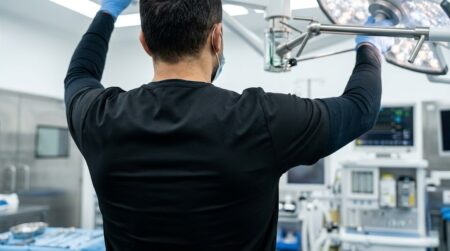
Modern scrubs originated in the surgical suite. They were designed for absolute function: easy to sterilize, cheap to replace, and color-coded to ensure they didn’t leave the sterile environment. In the 1970s and 1980s, these garments began to spread beyond surgery into general nursing practice. The comfort of drawstring pants and loose-fitting tops offered a level of physical freedom that starched dresses simply could not match.
Diversity and Gender Neutrality
The shift to scrubs was also influenced by the second-wave feminist movement and the increasing number of men entering the nursing workforce. As gender roles became less rigid, the demand for gender-neutral designs grew. This led to a wide range of Men Scrubs and Women Scrubs that focused on anatomical fit rather than symbolic femininity. The emergence of Printed Scrubs further allowed nurses to personalize their appearance while maintaining a professional standard, particularly in pediatric and long-term care settings.
21st Century: Fabric Technology, Inclusivity, and Branding
Today, nursing uniforms have transitioned into high-performance athletic wear.
Performance Fabrics and Tech
Modern uniforms are engineering marvels. 21st-century women’s scrubs often feature moisture-wicking technology, 4-way stretch, and antimicrobial finishes that help reduce odors and bacterial growth. For those working in colder clinical environments, the addition of specialized Underscrubs provides a layer of warmth without compromising the professional silhouette.
Inclusivity and Branding
The industry has moved toward radical size inclusivity, offering diverse cuts that accommodate every body type. Furthermore, private practices and large hospital systems now use uniforms as a branding tool. Coordinated teams wearing embroidered Lab Coats and color-matched sets project a unified, professional image that reinforces corporate or clinic identity.
Cultural Meaning and Professional Identity Today
While the starched cap has largely disappeared, the professional identity of the nurse remains tied to their attire. Modern scrubs are a balance between comfort and clinical authority. A well-fitted, clean set of scrubs still commands respect and fosters trust, proving that while the fabric has changed, the underlying symbolic weight of the uniform remains.
Short Timeline: Key Dates and Shifts
- Mid-1800s: Early charitable nursing uniforms; Florence Nightingale introduces the symbolic white dress.
- Late-1800s: Standardized nursing school uniforms and hierarchy-based caps emerge.
- 1914–1945: Wartime utility demands lead to shorter hemlines and simpler, mass-produced designs.
- 1950s–1960s: Introduction of synthetic blends and the gradual decline of decorative starched elements.
- 1970s: Scrubs begin to move from the OR to general hospital wards for increased comfort.
- 1990s: The starched dress and cap are almost entirely replaced by separate tunics and trousers.
- 2000s: Performance fabrics and specialized brands revolutionize scrub comfort and style.
- 2020s: Focus shifts to antimicrobial finishes, sustainability, and radical size inclusivity.
FAQs
Why did nurses stop wearing white dresses and caps?
The shift was primarily driven by the need for better hygiene and physical mobility. Modern medical environments are too fast-paced for restrictive dresses, and caps were found to be potential carriers of bacteria.
When did scrubs become common outside the OR?
Scrubs began their widespread adoption in general nursing throughout the 1970s and 1980s, as hospitals sought more practical, gender-neutral, and easily laundered options.
Do nurse caps still have meaning today?
In most modern settings, nurse caps are purely ceremonial, used during graduation or “pinning” ceremonies to honor the history of the profession.
How have uniforms affected patient perceptions?
A clean, professional uniform—whether a traditional dress or modern Lab Coats—consistently increases patient trust. Color-coding also helps patients quickly identify the roles of different team members.